
General conditions
VAT is included in the price of all our services.
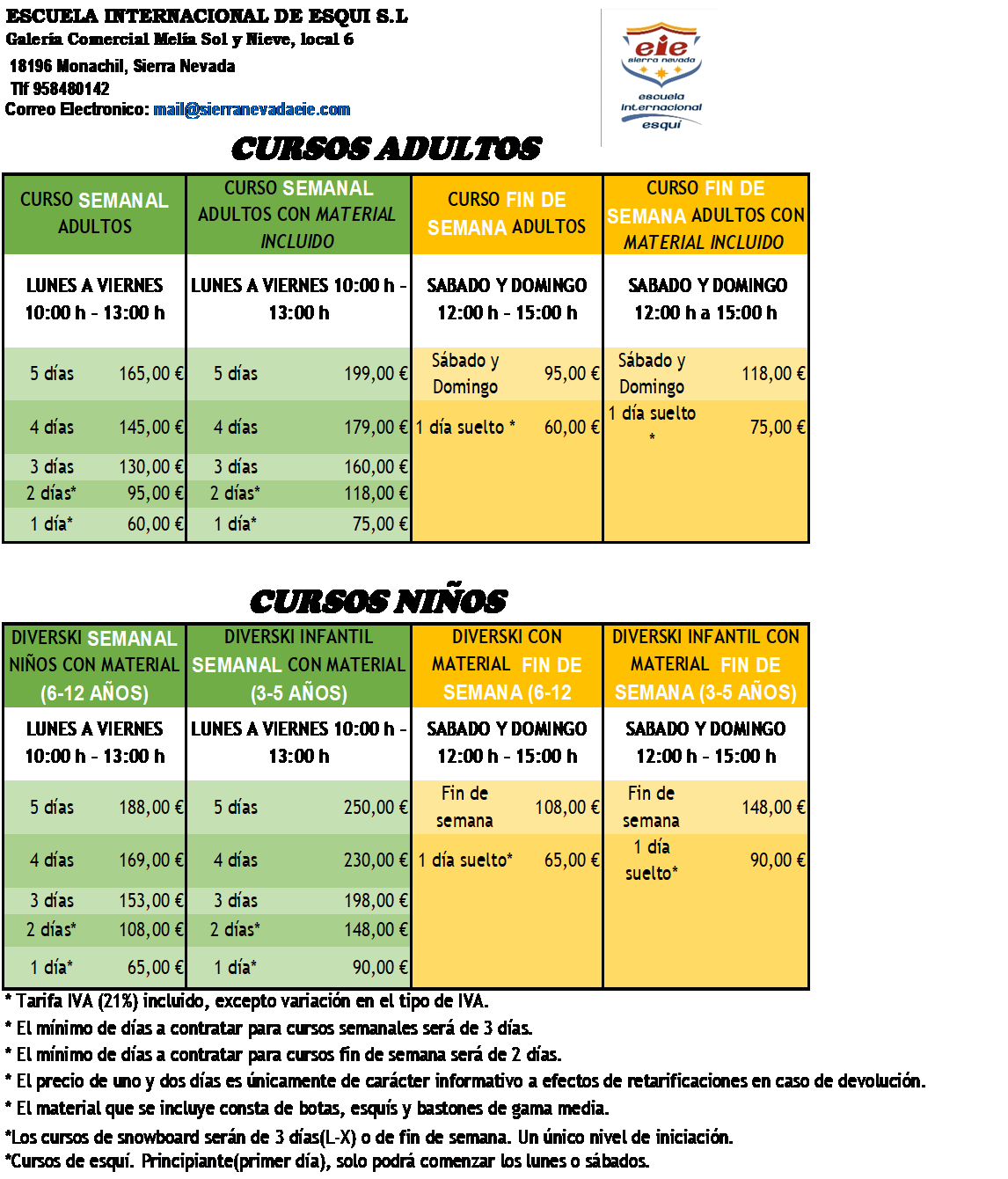
The material included in the packages consists of mid-range boots, skis, and poles.
The use of a helmet for children under 12 years of age is mandatory, so if they do not have one, it will be given to the client free of charge by paying a cash deposit of €30.00/helmet, refundable in full upon delivery of the helmet on the last day of class.
The timetable of the courses is from 12 pm to 3 pm for special dates and weekend courses.
The special dates are; From 6 to 8 December, from 26 to 29 December, from 2 to 4 January, from 5 to 7 January and from 28 to 31 March.
The schedule of the standard weekly courses is from 10 am to 1 pm.
The Beginner level of the courses is only available to all ages starting on Mondays or Saturdays and on courses on special dates.
Snowboard courses are only available for adults (from 13 years old) and only for beginners. They can be from Monday to Wednesday. On special dates, or on weekends. For SNOWBOARD children only private lessons.
The courses will start from 6/12 until 7/04 (included).
The minimum number of days to be hired for weekly and special courses is 3 days and 2 days for weekend courses.
The maximum number of students in the course can be exceptionally 9 in adults and children in high season and 5 in children's skiing.
The schedule of private lessons will always be on request and subject to availability.
Agency vouchers will be delivered at least one hour before the start of classes at the Plaza de Pradollano location.
Recommendation: It is important that children bring a snack in a pocket to consume during the class break. Due to COVID restrictions, backpacks or bags will not be accepted at our Borreguiles office.
Product types: - Children's Diverski:
children from 4 to 5 years old, with a ratio of 4 students per teacher. Exceptionally 5 in high season. Initiation and Initiates Level.
- Diverski Children: children from 6 to 12 years old, with a ratio of 8 students per teacher. Exceptionally 9 in high season. Levels P, B, C.
Refund and cancellation conditions:
For all services offered by the school (classes, material and ski pass), refunds will only be made in the event of total closure of the station or illness or injury with a medical report.
In case of early cancellation for rental and classes, with a minimum of 24 hours, with full refund.
And for ski passes with a minimum of 72 hours before the start day, free cancellation, (except advance sale passes) purchased until November 10.
A single access to any ski lift already prevents any exchange or return from being made.
Advance sale passes: No refunds, only change of dates. In this case, the difference resulting from the quote of the new ski passes at the time of purchase must be paid.
Discounted ski passes such as those for children, senior+, or disabled, are exempt from any refund.
In all cases, the amount to be refunded will correspond to the repricing of the contracted services, i.e. the difference between the price initially paid and the price of the services finally enjoyed. The form of return will always be the same way in which you made the payment.
Example: if a 5-day child course is contracted with a credit card whose price is €188and there is station closure for 2 days, the service enjoyed would be in 3 days, whose price is €153, with the corresponding refund being €188 - €153 = € 35, also by credit card.
In case of breakage or loss of ski or snowboard equipment, the customer will pay the amount corresponding to its value: 150 euros for mid-range skis or snowboards; boots 100 euros; poles 15 euros. On high-end skis the price will be between €200 and €450, depending on the model.
Below are the prices for 1 day of course exclusively for refund purposes. Under no circumstances will these services be commercialized.
Without Material:
Adult 60€, Children (6 to 12 years) 65€, Children (4 to 5 years) 90€.
With Material:
Adult €75, Children (6 to 12 years) €65, Children (4 to 5 years) €90.
Rates
:

sure
- The school has the corresponding Civil Liability and Accident insurance, guaranteeing all the coverage set by law (Decree 20/2002, of 29 January, on Tourism in Rural Areas and Active Tourism and Decree 26/2018, of 23 January, on the organisation of tourist camps, modification of the above).
RULES AND SAFETY TIPS:
Below you will find some rules and tips for safety on the slopes. The emergency telephone number on the track is: 900 249 100/112.
Rules for the use of Sierra Nevada facilities:
- The use of the facilities by persons outside the service of the facilities must be, except in cases of force majeure, exclusively for sports or tourist uses.
- The user must be aware of the particular conditions and rules of use of each installation and, in accordance with them, must assess his or her own suitability for their use. The use of the facilities will not be allowed to people who are drunk or who, for other well-founded reasons, could suffer or cause any type of accident.
- Any information or warning signs must be respected, as their purpose is to provide a better service and, above all, greater security. Likewise, the station's beacons, closed tracks, danger, cut areas, etc., must be respected, whether they are by signs, nets or cordons.
Especially respected should be the areas for beginners, in terms of speed and skiing.
- For reasons of civility and safety, the strict order of arrival in the use of the facilities must be respected. The waiting area will be suitably marked and prepared for use. The staff of the company operating the ski lifts and the inspection, in possession of the documentation proving their position, will have preference in the use of the facilities. Likewise, the teachers of the Ski Schools may have preference in the exercise of their functions, accompanied by a limited number of students, under the conditions proposed jointly by them and the concessionaire company and approved by the Provincial Delegation of the Ministry of Tourism, Commerce and Transport of Granada.
- The staff of the operating company, as well as those of the Schools previously circumvented, shall be duly trained, uniformed and identified.
Their orders or suggestions must be heeded, especially in case of danger or emergency, since their main objectives are safety and customer service.
- The staff of the operating company may require, when there are queues of users, that the different lifts go with all their places covered, in order to avoid increasing waiting times.
- The purchase of a ski pass entitles you to the use of all the facilities and courts open to the use of the public. The ski pass is non-transferable, the resort cannot be held responsible for its loss or misplacement.
- Any traveller who uses a facility without being provided with the corresponding ticket will be placed at the disposal of the competent authority, which will establish, after the appropriate legal procedures, the appropriate penalties.
If, during the operation of the resort, - for safety reasons or any other justified reason, the management of the resort is forced to close its facilities and slopes to the public, this does not necessarily require a refund of the amount of the ski pass.
There will be a - complaints book for each type of installation that will be located in the central premises of the station, available to users and whose existence will be announced by a sign indicating this, clearly located at the ticket offices. Any complaints made will be forwarded by the operating company to the inspection services, in accordance with the deadlines and requirements set out in the regulations.
- Failure to comply with these Rules, regardless of the application of the penalties provided for by law, will entitle the operating company's personnel to prohibit the use of the facilities, where appropriate and as a safety measure. This Resolution shall enter into force on the same day as its publication in the Official Gazette of the Junta de Andalucía. Seville, 17 December 1984.
FIS Standards
The International Ski Federation (FIS), founded in 1924 and to which 54 federations are affiliated, approved the FIS standards in 2002. An ideal role model for skiers, snowboarders or anyone else who slides on snow, whose goal is to avoid accidents.
Rules for the Conduct of Alpine Skiers and Snowboarders
- Respect for others: The skier or snowboarder must behave in a way that does not harm or endanger others.
- Speed and behavior control: The skier or snowboarder must ski in a controlled manner. You must adapt your speed and way of skiing or snowboarding to your personal ability and to the general conditions of the terrain, snow and weather, as well as the density of traffic on the slopes.
- Choice of route: The skier or snowboarder coming from behind must choose his path in a way that does not put those in front.
- Overtaking: Overtaking can be done up or down, right or left, but always in such a way as to leave enough space to prevent voluntary or involuntary evolutions of the skier or snowboarder ahead.
- Entering the Slope, Starting to Slide and Turn Up: Every skier and snowboarder who enters a slope, resumes his march after stopping or evolves upwards should look up and down the slope to make sure he can do so without causing danger to himself or others. Stop on the slopes
- : Every skier or snowboarder should avoid parking unnecessarily in the narrow passages or without visibility of the slopes. In the event of a fall at one of these locations, you should move out of the way and clear the track as soon as possible.
- Going up and down on foot: The skier or snowboarder who goes up or down on foot must do so on the side of the slope.
- Respect for beacons and signage: All skiers or snowboarders must respect beaconing and signage.
- Providing assistance: In the event of an accident, every skier or snowboarder must render assistance.
- Identification: All skiers or snowboarders who witness an accident, whether or not they are responsible for it, must identify themselves and exchange names and addresses.
General Comments on FIS Standards
Skiing and snowboarding, like all sports, involve risks. The FIS rules concern all skiers and snowboarders, who must be aware of and abide by them.
Anyone who causes an accident by violating the Rules may be held civilly or criminally liable.
- The skier and snowboarder are responsible, not only for their own conduct, but also for their defective equipment. This also applies to newly developed materials.
- Collisions are often the result of excessive speed, uncontrolled behavior or insufficient observation of traffic on the track. The skier and snowboarder must be able to stand, turn, or move within their field of vision. It should be driven slowly in saturated areas or places where visibility is reduced and especially at changes in elevation, at the end of the slopes and at the accesses to the ski lifts.
- Skiing and snowboarding are free-ranging sports where everyone can go wherever they see fit, respecting the rules and taking into account their personal ability and the prevailing conditions in the mountains.
The skier or snowboarder in front has preference. A skier or snowboarder coming from behind another in the same direction must maintain a sufficient distance between himself and the other skier or snowboarder so as to leave the one in front of him enough room to move freely.
A skier or snowboarder - who overtakes another skier or snowboarder is fully responsible until the maneuver is completed in a way that does not cause any difficulty to the skier or snowboarder ahead. This rule applies even when overtaking a stationary skier or snowboarder.
- Experience proves that entering a track or resuming the descent after a stop can be the cause of accidents. It is therefore absolutely essential that a skier or snowboarder who finds himself in this situation enters the slope without causing obstructions and without danger to himself or others. When a skier or
snowboarder is in motion – even if slowly – he or she again benefits from the privilege provided for in Rule 3 in relation to the fastest skiers and snowboarders coming from above or behind.
The development of carving skis and snowboards allows those who use them to execute turns uphill on the slopes. In this case, users are moving in the opposite direction to the general downward movement. It is therefore obligatory for them to ascertain in advance by an upward examination that they can do so without causing danger to themselves or others. - Except on wide tracks, stops must be made at the edges of the track. You should not stand in narrow places or where it is difficult to be seen from above.
- Moving contrary to general traffic puts disturbing and unpredictable obstacles in the way of skiers and snowboarders.
Deep footprints made by the feet damage the track and are dangerous for skiers or snowboarders. - The slopes are marked according to their degree of decreasing difficulty in black, red, blue and green. The skier or snowboarder is free to choose their slope.
The slopes are also equipped with other signs that show the direction and warn of danger or closure. These signs must be respected imperatively for the benefit of skiers and snowboarders. - Assisting a skier or snowboarder in distress is a sporting moral obligation, if not a legal obligation. It consists of providing first aid to the injured person, informing the rescue service and marking the place of the accident to alert other skiers and snowboarders.
The FIS expects that the offence of absconding while skiing or snowboarding will be criminally punished as the offence of absconding on the road in all countries where legislation does not already provide for it. - Witness relationships are of great importance in writing a complete and accurate accident report. Everyone must fulfill this moral duty as a responsible person and report as a witness.
Reports from the rescue services and the police, as well as photos, help considerably in determining possible responsibilities.
Safety Tips
What to bring to the snow
- The use of warm and waterproof clothing and footwear is recommended. It's best to dress in layers so you can easily adapt to temperature changes. The air between garments is the best insulator.
- It is important to remember to wear the three G's: gloves, goggles, hat. If you are going to ski or snowboard, as in other sports such as cycling, a helmet is the right thing to do.
- Recently, the use of other protections such as back protections is spreading. Indeed, the speed and the existence of obstacles make it advisable to protect yourself well.
- While enjoying the snow, we sometimes forget that we are exposed to dangerous ultraviolet rays. We should protect ourselves with a cream of at least factor 30.
- The cold often masks the feeling of thirst, but in order for your muscles to function well, you need to stay well hydrated.
You choose the track
- You have to acquire the skills progressively, going from the easiest to the most difficult.
- Green: Very easy. For beginners, wedge turns.
- Blue: Easy. Medium Level. Parallel skiers.
- Red: Difficult. Good skiers or snowboarders.
- Black: Very difficult. Experts.
- Snow conditions and weather can accentuate the difficulty. Know your limitations and be cautious, in this link you will find a map of Sierra Nevada slopes: https://sierranevada.es/es/invierno/la-estaci%C3%B3n/en-pistas/plano-de-pistas/
Safety Tips
- Do not ski or snowboard off-piste, or enter enclosed areas.
- Do not approach the edges of the track, to avoid going off unexpectedly.
- For the same reason, it is advisable to stay away from windbreaks, cannons, bollards or other obstacles.
- Bring well-prepared skis and boards (edges, soles, bindings). A little maintenance of the material guarantees greater pleasure and control.
Tips for Pedestrians
- In Sierra Nevada, areas are prepared to slide with doughnuts or sleds in a safe and comfortable environment.
- Do not leave the areas prepared for pedestrians or walk on the ski slopes. There is a risk of collision with skiers.
- Sliding with shovels or plastics or in areas not controlled by the Station is very dangerous. Access to gondola lifts with sleds, paddles or plastics is prohibited.